Showing posts with label write club. Show all posts

Friday, September 25, 2015

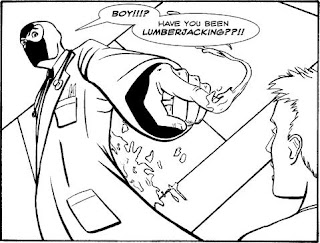
Write Club: How Not to Write with Dr. McNinja

Hey y'all.  So the webcomic Dr. McNinja is coming to a close.  It's a fun webcomic, if randomness is what you're after.  Y'know, what with a doctor who is also a ninja, and all the silliness that Chris Hastings decides he wants to jam in there.


However, as much as people like it, it's kind of...well, not great.  Several things about it get on my nerves.  Given that I'm not a fifteen year old male, that's to be expected.  But when I was younger, I did in fact share many likes with that particular demographic, which is how I got started with it, when it was...oh, about the beginning of issue three.  I really liked it at the time, but at the end of issue three is when Gordito was introduced.  I somehow got the feeling that something had gone wrong in the comics, and that Gordito's entrance would somehow damper the comic.  I was half right.  Something did change, but it wasn't his fault.  Interestingly enough, Hastings mentioned in an interview that issue three was in fact a turning point for both himself and the comic.

This isn't going to be a proper review, for the record.  There are many reasons why a review of it isn't entirely appropriate.  For one thing, Dr. McNinja appears to be something Chris Hastings created more for fun than anything else.  It comes across as more stream of consciousness than straightforward, and serves as a way for Hastings to develop his comicking/storytelling abilities.  This tends to be the case with many webcomics. The long stretches a webcomic lasts mean that they can't always think of everything as a narrative the same way a novel writer would.  Everyone needs practice, so what better way for a comic guy to practice than to make a webcomic?

There's many positive aspects of the comic.  It's funny, and has good ideas on how to parody life as it is.  If you're a guy who enjoys stupid humor, I highly recommend you take a look at it.  Note that I don't mean "stupid" as an insult.  "Stupid humor" is pretty much its own genre by now, is all. Y'know, the kind of humor that makes people laugh at how dumb it is.

However, I've always wanted to get off my chest why exactly this comic gets on my nerves at times.  As a result, the things I write here will make the comic seem more negative than it really is.  Bear in mind that despite these errors, the comic is not the worst thing ever, or horrible in general.  It's fun for what it is.  This will just be a post addressing the writing errors present within the story that any writer worth their salt should be aware of.  Flaws in storytelling transcend their particular mediums, in most cases.

Alright, so quick story summary.  Dr. McNinja is an Irish American ninja who abandoned his family's more ninja occupations so that he could become a doctor.  After teaming up with tween Gordito, nephew of the Mexican raptor bandits, he goes after such enemies as ninja-killer Frans Rayner and ruler of all things cool King Radical.  Together they face time travel, evil dinosaurs, a weatherman, giant robots, and all manner of random whatnots.

This post will probably be easier to understand if you've already read the webcomic.


Sunday, March 31, 2013

Write Club: What Not to Write

Hey y'all.  Some time ago I made some notes about what a writer shouldn't do when they write.  And now I found the paper again when I was organizing my bookshelves.  So why not share it?

There are certain things a writer shouldn't do.  Either the consequences can be on themselves, their readers, or both.  Writing and reading communication with the innermost parts of the authors' souls, and they show themselves in ways they didn't realize.  My english teacher said that what you write hides you from the world, and she says she can write something without someone knowing she is southern or a woman.  I disagree.  While no one who reads what you write will know what you look like without seeing your picture on the back cover, they will see your soul.  And which is deeper, your skin or your soul?

My english teacher's soul is not particularly southern, but I've noticed that women writers tend to make themselves obvious (to intuitives, anyway), and it is possible to guess the gender of a writer even if they don't mention it.  The more you understand the souls of people, the more you can intuit about a writer from their book.  Sometimes even unintuitive people can guess, especially if they are social and know how people act.

That being said, here's number one of what writers shouldn't do.

1. Don't emphasize your superior (or "superior") knowledge/vocabulary/ideology.

Arrogant people are nobody's favorite, especially when the arrogant person lifts themselves up at the expense of the reader.  They know when you're making fun of them, or contradicting their beliefs.  You're not fooling anyone when you write a children's story with "disguised" vegetarianism and yoga-type mysticism.  You're not impressing anyone when you spasmodically obfuscate facile lexeme.  It's very nice that you know how steamboats work, Mr. Twain, but that doesn't mean you need to have three pages worth of a kid pretending to be an audibly accurate steamboat as he goes along.  Seriously, that totally could have been cut out of Tom Sawyer.  I skip it every time.

Friday, March 15, 2013

Write Club is Up!

Hey y'all!  I'm proud to announce that Write Club now officially exists on Facebook!  I created it the other day, and will be working on it through the next year.  This group is for those who wish to be surrounded by those who write and find the motivation for writing when we don't feel like it.  I'll be posting things like exercises and tips, and members can feel free to do the same.  So, if you would like to be a part of the group, just go ahead and search for "Write Club" on facebook and ask for an invite.

The only requirements to this group are that you yourself are a writer.  The stuff we post is for author critiquing, and not for readers yet.  You must "audition" by messaging me (Bethany) and send me a sample of your work.  It can be fiction, nonfiction, or poetry.  Just something that you wrote yourself.  You don't have to write anything new.  Just send a segment of something you've already written and you enjoy.  For poetry, please no longer than a page.  For everything else, no longer than two pages.  This is just an audition, not a critique.

Anyway, I hope to see you there, and hopefully this group can become something big one day!  Thank you!

Saturday, September 29, 2012

Number Shrinking

Hey y'all

One of the things I would like Write Club members to do is to give NaNoWriMo a serious attempt.  If they fail, it won't be because they didn't try, I hope.  Time constraints are often a problem, so as long as they put in a good effort, I won't be disappointed.  After all, 50,000 words is a lot, especially for new writers.

The trick is to do number shrinking.

What we are shrinking is not the amount of writing done, but the perception of how much writing you feel you have ahead of you.  I've figured it out.  The first number is of course fifty thousand.  November has 30 days in it, so divide 50,000 by 30 and you get 1,667, rounded up to a whole number.

That's still a bit longer, isn't it?  Can we shrink this further?  Sure.  Now, I'm a simplistic person, and thus I hate Microsoft word.  I don't like all the extra features, and especially not that red line that appears at the bottom of words you misspell (fantasy writers want to misspell some stuff, Word).  And so I use Wordpad until I want to edit a document with special formats.  And when I got a new computer, I even transferred the old Wordpad over so I wouldn't have to use the new, too feature intense Wordpad.

Thus, the area in which I write isn't shaped like a piece of paper.  It's just a wide area almost as wide as the computer screen itself.  Therefore, I counted the number of words per line and got and average of 44.  Also, I counted the number of lines of text that I could could see at one time without scrolling down.  I got thirty six -- you might get more on your screen, because my screen is kind of narrow.

In any case, thirty six lines of forty four words comes out to 1,584 words per screen.  Thus, writing one screen of text gets me almost one full day's worth of writing done.  Doing the math, it takes only 1.1 screens worth of text to get what I need to fulfill a day's quota of text and thus win NaNoWriMo.  See how that works?  50,000 shrunk all the way down to 1.1.  Surely 1.1 screens a day won't kill me.

However, there are two problems with my figure of 1.1.  First of all, not all of you like to use Wordpad, and your monitors are differently shaped from mine.  This problem isn't too bad, however.  There is no reason why your number shouldn't be too different from mine.  Just follow this process:

    1. Count how many words per line for at least five lines of your work that go across the screen.  Add these numbers together, then for however many lines you counted, divide the total by that number.  So if you counted five lines, divide by five.  Round to the nearest whole number.

    2. Count how many lines fit on one of your screens.  The easiest way to do this is to just type a letter, hit enter, type a letter, and enter again repeatedly.  Let your first letter be a capital letter, and then pick another letter and enter it over and over until your capital letter will go off the screen with the very next enter.  Then simply count the number of letters you have on your screen.  It helps with counting if you made every tenth letter a different one.

   3. Multiply the number of words per line by the number of lines you have per screen.  This will give you words per screen.

   4. Divide 1,667 (that is, the number of words per day to beat NaNoWriMo) by the number of words per screen you got.  This will give you the number of screens you have to complete per day to win NaNoWriMo.

I hope all that math didn't confuse you.  It's not as hard as it seems.  It only involves simple math anyway.  Trust me, if it were complicated I wouldn't be able to do it.  I wish I knew physics.  Then again, I wish I knew everything, so let's just move on.


The second problem with the 1.1 figure is that this entails writing 1.1 screens of single-spaced lines that go completely across the screen.  Due to dialogue, double spacing between paragraphs, and lines that just plain don't go all the way across, that 1.1 screens of full text will inflate to two or, if dialogue goes on a long time, possibly three screens in practice.  However, this isn't all that daunting.  Two and three are still smaller numbers than 50,000, so the vastness of writing that many words in a month has still gone down.

Besides, if I get caught up in the heat of the moment of writing, I find myself writing more than my daily quota.  This should cover me up on the days I might not make it.  So therefore, don't count your words during NaNoWriMo.  If you must, do so only once on the 15th or the 16th, and then one final time on the 29th to give yourself energy for a writing sprint.

Don't count early on, and don't count on the last stretch.  It will discourage you if you do it too much, especially early on.  If you count in the middle or almost to the end, you will be able to think to yourself, "Wow, I really did all that!" instead of "Crap...I suck."

Thursday, September 20, 2012

Write Club: Week 2 -- 9/19

For this meeting, I thought I would have to do a recap of last week's meeting.  As it turned out, we only had one new person show up.  I was hoping for more, but this thing is to be expected.  People can be enthused about something, but then their excitement wanes.  Besides, I like having a smaller group anyway because we can discuss more.

For starters, we did a two minute forced write on what fruit that person believes they are.  Why don't you do one too?  I picked blueberry because they're not really blue.  They're very different from what their outside implies.

During this meeting I discussed information, and training your brain to make itself be creative.  The thing is, usually the places that inspire us are not the places where we write.  One member of our club was inspired by the lighting section at Lowes, and another was inspired by gas stations.  But nobody ever writes at those places.  We write at home, in our room or on our couches.  So the key is to force ourselves to be creative in the places that we write.


Tuesday, August 28, 2012

Write Club: Things Not to Do

Hey y'all.  This is going to be the first of what I suspect will be an ongoing series of little things -- or not so little things -- writers do that are so dang irritating.  Sometimes it's so bad that I just can't keep reading. 

One of the things a writer can do to alienate the reader is talk to them as if they're children.  Even in children's books, this is unbearably irritating.  Y'know, when writers treat the simplest, most trivial metaphors are all dang clever.  And acting as if they know everything and have to make it much simpler sounding so you'll understand.

This is what Michael Coren, author of J.R.R. Tolkien, the Man who Created Lord of the Rings, has done.  Ugh.  There's nothing that can prove my point better than some quotes.  Here's the quote from the introduction, where Coren is talking about a survey done where Britain is trying to find out what book people feel is the greatest book of the twentieth century for England.  Of course, given the book, the survey obviously shows that LOTR won.  Coren then mentions some people who disagreed with the survey, calling them elites.

Monday, July 23, 2012

How to Doom Your Sequel: Star Fox Adventures

Hey y'all.  So I've been watching let's plays of all the Star Fox games, because it's a great series.  Star Fox is  the story of anthropomorphic animals who save the universe from the evils of the great monkey robot genius Andross, who is constantly trying to take over everything.

Of course, it was a great series before things went horribly wrong.  Obligatory summary-ho!  Just a short one, though.  I get pretty sick of recapping something when I really want to be talking about something else.

Anyway, the glory of the first Star Fox game was in its simplicity.  It's basically where you play as Fox McCloud, a fighter pilot, and you have to fight your way through a path to the planet Venom where you must defeat the evil scientist/robot/monkey Andross.  This is a lot of fun, especially since the graphics on the SNES where so blocky and "retrofuture" -- what the past thought the future would be like.  It seriously reminds me of old sci-fi book covers.

In 2007, I once read an old book where kids from the fifties went into the year 2007.  So, um, why don't we have flying cars again?  Um, yeah.  Retrofuture.


Tuesday, June 26, 2012

Write Club -- Prodigies


Hey y'all.  It turns out that my dad's cell phone acts as a hotspot, so I can do some writing on here even though home internet isn't set up yet.  Dad's cell phone, naturally being with him, isn't around all the time, but I can just write up blogs from my personal laptop (no internet there anyway -- too distracting for a writer) and then post them using the laptop.

So I was thinking about things lately, and I realized that there are no writer prodigies.  A prodigy is someone who is naturally gifted to be good at doing a certain activity.  For example, there are study prodigies who are good at learning, music prodigies, repair prodigies, and so on and so forth.  But there are never any writer prodigies.  Beethoven wrote a symphony when he was three, but no three year old of any sort can write a novel of any great significance.  Oh sure, they might get away with one of those odd little Beginning Readers books with ten words per page and a vast illustration (of course done by somebody else) but that is only on the whims of older people who happen to look at what the child is doing and thinks it's adorable.  Not big sellers or important novels.


Tuesday, May 1, 2012

How to Doom your Sequel 2: Dark Seed

Hey y'all.  I didn't think this was going to be a continuing thing, but I've been watching let's plays of the Dark Seed games, and it's like the developers of their second game really didn't want their sequel to work out.  It's like they did almost everything possible to make sure the game was weird and you hated the main character.  Normally I'm not a horror fan, as most horror these days is all gore and no scare.  However, the Dark Seed games are so cheesy hilarious, I figured I might check them out.

The first game was actually pretty decent.  It centers around professional writer Mike Dawson, who has just bought a really creepy house, for some inexplicable reason.  His first night there, he dreams that an alien baby has been implanted in his head.  From the headaches Mike experiences every morning, you figure the dream was real.  This is a horror game, after all.

So Mike has to do several things and claim several seemingly insignificant items to enter the dark world, a place more or less parallel to the normal world, only creepier and nastier.  From here, he has to find a way to stop the ancients, an alien race, from using the baby in his head to take over both worlds -- because apparently, while creepy, the normal darkworlders are just....well, normal.  One of them, a disembodied head, is the person who sends Mike dreams every night and helps him win the game.

There are several problems with this game.  First of all, it is very, very difficult.  Without a walkthrough, you will find yourself dying several times.  And because you don't pick up a specific object, or don't complete a task fast enough, you can easily get yourself into an unwinnable state without even realizing it.  Also, every time you die, the game forces you to go back to the beginning, including watching the scene of Mike getting a baby implanted in his head again.  Save early, save often.

But overall the game itself was pretty good.  Not the best thing in the world, but it was a great start to a potentially rewarding franchise.  If the second game hadn't happened, anyway.


Tuesday, April 24, 2012

Write Club -- How to Doom a Sequel

Hey y'all.  So I was thinking about it, and there are things that moviemakers do either by accident or by well-intentioned mistake.  It generally doesn't happen as often with books, particularly considering that it takes so long to write a book and publishers seem to care a whole lot more than producers whether or not their product is good.  Considering that movie makers can get away with a lot dumber choices and still make money...well, yeah.

Maybe this is just a personal vendetta from a writer type, but it seems to me that movie people should be punished by lower sales when they make dumb stuff.  Unfortunately, even things like "Jack and Jill" and "Zookeeper" seem to make a crap ton of money, probably because people are bored and movies are there.  Fortunately, making fun of bad movies is entertaining.  A win-win situation, I guess.

Anyway, I just want to illustrate a few things that illustrate what can make a sequel turn bad.  Everybody's aware of sequelitis, where a sequel just doesn't measure up.  Sometimes it's just a matter of not being quite as good, but still being well-made and watchable.  Other times....well, not so much.


Sunday, April 8, 2012

Write Club: Respect Characters

Hey y'all.  So I was critiquing somebody's writing online, and the thing I noticed about this particular work they wrote was that it was missing an integral part of all good stories: the love of characters.  The sample I read was a prologue, and it was quite obvious that the characters in it were mere tools to get on to the first chapter.  None of the characters were particularly interesting.  They were merely there to serve a purpose, and then they were gone.

This is not the way a character is to be treated.  A character is not merely a tool, but a little person living in the fictitious world that you made for them.  They are little organisms, based on yourself and people you know.  They are given life by your perceptions, and become more deep the better you perceive.

The trouble is, there are errors with people's perceptions.  Most of the problems with the above writer's sample was the fault of one such error.  He combined.


Friday, March 30, 2012

Write Club -- Which Reviewer Are You?

Hey y'all.  So I was reading this book, "How to Succeed in the Publishing Game" by Vickie Stringer. She was talking about all the different aspects of editing. Apparently in the business there are three types of editors. Copy editors, content editors, and book doctors.


Tuesday, March 27, 2012

Write Club -- Bigotry and Ego

Hey y'all.  So, as a writer, one should try to be as unbigoted as possible.  It's actually a little easier for the writer, as the writer looks at different kinds of people and is inspired by them.  This, however, doesn't mean that the writer is entirely immune from bigotry.  I don't know how many times I've read a book, only to discover that the author has condescendingly taken an antagonistical character and given that character all the opinions the author disagrees with, merely to use this character as a whipping boy for the author's narrow-mindedness.

Like, for example, the author will take a "Christian" character and have them be the biggest jerks you've ever seen, or make them act so inhuman you have to wonder if they're really aliens from space.  And honestly, how many times is that trite old "the government is always evil" stereotype going to work for some authors?  I'm so bored already!  And I'm even more bored of the feminist stereotypes, who are ridiculously self-righteous and antagonistical to men, even though they're supposed to be the protagonist.  Yawn!

However, there is a time when bigotry and stereotypes are a good thing.


Wednesday, February 22, 2012

Write Club -- Worthless Opinions

Hey y'all.  So that title up there sounds kind of harsh, doesn't it?  Well, basically, it's something all writers have to understand, generally more by experience than by being told: there are some people whose opinions are not really worth considering or considering deeply when it comes to your writing.

You, as a reader of other people's work on the internet, are likely to be frequently annoyed when a writer gets antsy or defensive at the slightest criticism.  You've seen some people freak out because someone pointed out legitimate errors in their work.  You don't want to be like them; you want to be understanding, willing to listen, and willing to learn from your mistakes.

The problem with that is, not everybody's a real teacher.


Tuesday, February 7, 2012

Write Club -- Mood Control

Hey y'all.  So I was talking to an aspiring writer that I know on Blizzforums, and he sent me some samples of writing he did when he was in his teens.  I'm a picky critic, poor guy, and I really let him have it.  He dealt with my critiques very well, though, and he asked for a challenge so that he can show how much he improved over the years.  And I agreed.

The challenge I came up with was one to test his ability to control his audience.  That's right, all forms of writing involve mind control.  Specifically, writers are meant to grab people by the emotions and make them feel a specific way.  Many flaws in writing can be forgiven if the emotional control is good.

Wednesday, February 1, 2012

Write Club -- Fiction Genres

Hey y'all.  So a while back I wrote up a list of fiction genres as a guide to other writers.  I didn't necessarily write this to merely describe the genres, but to describe the purpose of each genre and why a reader likes each one of them.  Having these sorts of ideas in your head can make it easier on you to decide on what your book should be.  Remember also that your book is a product.  Exactly who is your audience?  You must therefore know what the reader wants when he picks up your book so that you can cater to them.

This is how you know I'm a nerd -- I care way too much about details.  Anyway, here we go!

1. Fantasy - The readers of this genre have a longing for the old times, a longing for "magic" and the impossible.  They desire a reality different from the austerity of the normal.  This genre is tied to escapism, philosophy, and desires that are not yet reached or might never be reached.  Tends to have a tragic tinge for some reason, though that is not required.

4. Sci Fi - This is the "older brother" of fantasy.  The readers of this genre also desire things better than reality, though in this genre the journey is less magical and more humanistic.  This genre is heavily philosophical, as it deals with a focus on the future and human nature.  It either claims that humanity is great, for whatever reason, or that humanity is a plague.  Or both at the same time.  The readers here want new ideas and new scientific concepts.  Or, sometimes, they want to dispute other people using a "scientific basis" -- which is pretty odd considering that this is fiction and can neither prove nor disprove anything.

3. Japanese/Asian - Technically speaking, this can be any genre it wants, though most of which comes over here to America and such tends to be either science fiction or fantasy.  There are a few things which distinguish Japanese fiction from the other two, mainly their division between boy and girl fiction.

- Shojo (girl) - The readers of this want female heroes, particularly ones that are odd characters, usually by means of their innocence or their magical power, depending on how realistic or fantastic the plot is.  Romance is a must, especially with a darker or more serious male, to contrast with the main character.
- Shonen (boy) - This genre is very philosophical, and often graphic.  The readers here desire violence and tragedy, mixed in with spiritual philosophies that are ironic and even painful.  Moreover, while Shojo often generally makes its lead characters more innocent than human nature, Shonen prefers the opposite.  Can be very depressing to certain readers, "realistic" to others, when it speaks of human nature.

Both of these half-genres are tied together by eastern philosophies, including aspects of Confucianism and Buddhism, though often they will borrow heavily from western philosophies and religions.  For example, the comic Sailor Moon includes both Roman and Japanese mysticism about the planets of the solar system.  These philosophies may often appear randomly, such as in a cartoon of a "butt-biting bug" whose ancestors came from ancient Assyria.  Easily the most religious of all fictions genres.

4. Detective/Crime - Readers of this genre desire mystery, but more than that they want clues, to be able to figure out what is going to happen in the end before you say it.  Writers here must make a balance, enough clues to help the reader make some conclusions about what will happen (and even misleading clues to throw them off at points) and also not enough clues to make the reader know everything that will happen.  Readers either want to be gratified in their superior ability to figure out clues, or else just be surprised by how daringly convoluted the ending can get without being completely impossible.

5. Realistic: Modern - This genre is a bit more open, but stories here generally include coming of age stories, or just stories of people getting through ordinary life with difficult problems or moral questions.  The readers here want philosophy and counseling, almost in the sense that they are asking the advice of the author how to deal with the problems they face or are likely to face, or even want to face (like being pursued by two love interests at once).  Many authors cater to what the reader wants to hear rather than what is the best solution, e.g. the leading woman gets everything she wants despite hurting her parents to get it.

6. Realistic: Historical - In this genre, the writers is usually trying to give perspective to someone who has been in a great historical event, or at least lived through a difficult time like a war.  The reader wants this story to relate the problems of normal living to the circumstances of different ages, and how it would be different for a person to live then, especially in matters of love or work.  They want to get the sense that they too are living through historically important times, and want to know how people get through these; either by bravery, cowardice, or simply going numbly through.

7.  Superhero - This is modern day fantasy, one that emphasized the strength of the individual.  Readers want characters that resemble the best parts of themselves, or who they imagine themselves to be, and the best superhero stories make the characters have powers that resemble their personalities.  Readers here are often people who feel lonely and desire to not only be powerful in some strange and amazing way, but to also be a part of a team of people who are also amazing.  They desire greatness because they see none in their personal lives.

8. Romance - This one should be obvious.  Readers here want a fantastic account of how two people fall in love, and all the troubles that it takes for those tow people to get together and live happily ever after.  Too often readers of the genre view falling in love and/or getting married as the point of life and that no one is capable of living unattached for any amount of time.  The most escapist of all genres, and the most effective at changing women's perspectives.

9. Western/Cowboy - This one is a more manly genre, most of the time, and it is anti-modern.  It's against the "wussification" of man and gives very manly themes, such as being tough, survivalism, right vs. wrong, and the value of women.  Can be very depressing at times, what with the underdeveloped medical situation of the times, harsh winters , and the plight of Native Americans.  Readers want manly philosophy and also ways to survive in rough conditions.  This one, generally more so than most other fiction, requires specific research as it is closely related to nonfiction and you can't make up your own science and lifestyle as you would if you set your story on a different world or faraway planet.  Readers can get very iffy about writers playing around with facts or not doing their research.  Any flaws will quickly be pointed out by regular western readers.

10.  Nautical or Exploration - Here readers want a freedom from distraction, a story with a more singular focus on observation of a culture or cultures on a journey.  They want new, amazing worlds and character with the ability to understand or related to these worlds.  For example, in the story Out of the Silent Planet, the character Ransom studies languages, and so is able to figure out the language of the Hrossa of Mars with scientific clarity.  While at times characters will not understand or will endanger strange new peoples, this has to be balanced out with rational characters so that the reader has time to learn about the new lands and people before the noob/jerk/assuming person creates conflict.

11. Children's - This is certainly the easiest.  Readers here (parents) want simple stories with low conflict, good and honorable themes that will help children grow into normal adults, and not too many fancy words or complicated metaphors.  The irony here is that adults' stories often have sick and demented themes, as if it's okay to be disturbing when we grow up.

12.  Teen's - Let me be very clear: I am extremely biased when it comes to this genre.  Notedly, extremely biased against.  Perhaps many years ago Teen fiction was a good genre, but now...huh.  Readers of this genre want either relationship fantasy (the more fantastic half of teen fiction) or they want, um, "realistic" portrayals of the toughness of being a teenager and all the possible pitfalls a teen can fall into.  Or a combination of both, though generally most authors don't combine.  There's no reason why not, if you feel like...well, except for the reason I'm going to write below.

The trouble is, teen fiction as it is at the moment has gotten so depressingly unrealistic (remember, both optimism and pessimism in life are inaccurate), and instead of making it easier to get through the teen years, most teen fiction is sick, demented, and makes their readers have generally negative opinions about life.  It gives teens a bias away from those in life who should be on their side: parents, church leaders, and any authority figure in general that doesn't follow the values of modernism.  Life is also generally portrayed as hopeless, and you must cling to whoever you can to survive.  For this reason, I often call teen fiction "wrist-slitter" fiction (though there is other types of fiction that fit in this category).

Now sure, family and church people are as flawed as anyone and some are even huge jerks, but for the most part that's not the case.  There's no reason to distrust them unless they give us a reason.  Likewise, life itself is what you make of it.  If you tell a bunch of teens that life is hopeless, as they grow up, they'll make sure it's hopeless.  That's what they'll believe.  So please, for the love of teens, give your teen fiction the spirit of life, not death and hopelessness.  Give teens strength to face the harshness of the world -- don't cut their roots out from under them.  Or you're a scumbag.

13.  Horror - The readers here want to be frightened or disgusted out of their wits.  They want original monsters or monsters that act in original ways to somehow hurt or attack people for whatever reason.  The monsters can be human or otherwise. This genre, more than others, requires a lot of mystery, and oftentimes it is best not to give your audience a full explanation of all that has taken place, or all of the motives of the baddies.  The best horror endings are the ones where either the bad guy wins, the good guy's victory is bitter and painful, or the bad guy shows signs of life and returns even as the good guy is walking away, thinking that he won.

14. Thriller - This is the brother of horror, as its readers still want to be frightened or disgusted out of their wits.  The key difference is that readers here want their characters to be more competent, and the audience focuses more on actually stopping or getting the best of the bad guys or monsters that are after the heroes, rather than all of the disturbing things that the bad guys do.  The best thriller endings are ones that lead to the bad guy going down, even if there is still the sting of tragedy.  Many readers here want victory, and will be very disappointed with an ending where the bad guy wins or gets away, the in the story No Country for Old Men.

15. Action - This is another sibling of the thriller, though unlike thrillers, action works try to be more (but not entirely) realistic, and don't include things like supernatural monsters.  This, more so than horror and thriller, wants to focus on the good guy, and less on the bad guy.  Most of ten told from the lead characters perspective.  This story is one that wants to inspire people to be excited, feel pumped, an feel good about being a hero.  If the bad guy is crazy, the readers want a hero who is crazy enough to stop him.  Victory here is also a must, even if it is sad.

16.  Tragedy - More often than not, this appears as an element of other genres rather than a genre of its own. Readers here want a story that is both intriguing and sweet, with characters they can really connect with.  Here more than anywhere else you need to have endearing characters who the reader loves, because no one cares in a story when annoying characters die.  While many authors try to include philosophy, or unanswered philosophy questions, emotion is more important than they philosophy.  The best tragedies are the ones who end with some bitter happiness, like how in Romeo and Juliet their two families come together and meet peacefully because the the deaths of the lead characters.

17. Comedy - As a written genre, this doesn't really exist anymore.  It exists either as an element of other stories, bitter comedian biographies, or as a movie.  Or it lives on in the writings of amateurs on the internet.  Not that writing comedy makes you an amateur, it's just that people these days generally don't write fully comedic things.  I'm not entirely sure why, though notedly culture of late (post Sept 11) tends to take life way too seriously.  Just look at movies and music.  They've both gone really melodramatic.  Even as late as the nineties people could still enjoy goofiness, though nowadays the only real goofiness people have is those stupid "comedy" movies done by people like Adam Sandler and Jack Black.  People are dang uptight these days.

I'm writing this in mainly as a dare for someone to write a really good comedy.  Not in the Shakespearean "happy ending" version of comedy, but a really funny book that isn't bitter like what comedians these days write.  Seriously, most of the jokes those guys make are really just little laughs that thinly veil the bitterness they have about life in general.

18. Tribal/Ethnicity - This isn't a genre in the same way as the others are, as every ethnicity writes one or more of the above genres.  However, I include it here because it is something a reader wants.  They want stories of their own people groups to learn more about them and about how their ancestors affect themselves.  Usually this is written by a person of the same or similar ethnicity, but if you're attempt to write fiction of a different one, research is very much needed.

19.  The News - That's right, I went there.  Readers of this genre want a summary of the truth, so that they will be informed and feel that they are intelligent and competent members of society.  More so than any other genre, this one is created by editing, not by writing.  The material comes in, but how it comes out is how it's presented.

For example, some time ago a few imams (Islamic priests) were going on a flight to somewhere in America, but frightened passengers wanted them to leave the plane, which they eventually were.  ABC News reported this as intolerance, and coupled this news bit with a segment on breastfeeding in public.  As you can see, that's a very....logical combination.   However, when an interview on the radio was done with a person who had actually been on the plane at the time, the witness reported that the imams were acting strange.  They refused to speak to anyone, and when the witness directly tried to, she was rebuffed.  The imams also prayed very loudly and did what they could to create a disturbance, as if they wanted to attract attention to themselves.

While in every genre the order or arrangement of events has a huge impact on the overall result of the story, in this one editing plays a huge role.  By lessening or increasing a certain type of people who speak on an issue, whatever the issue might be, newscasters create a story which leaves an impression on the minds of people in general.  Therefore, they also are writers of what could potentially be fiction, not out of conspiracy, necessarily, but out of the very nature of their jobs.

Monday, December 12, 2011

Write Club: Types of Writers

Hey y'all.  It's about dang time I updated this blog.  I usually only do when I get ranty, and now I'm ranty again.  I promise I will get to reviewing the MM10 soundtrack at some point in the future, but for now, it's writers.

Okay.  First of all I would like to point out that everyone is a potential writer.  Not "writer" in a narrow sense.  Every one of us can use writing in accordance with our regular and preferred occupations.  There are three general types of writers: Fiction writers, Non-fiction writers, and Non-writers.  Yes, Non-writers are a type of writer.  Deal with it.

What these basically mean to say is that it takes a special sort of person to be the first two categories, whereas all writers start out as Non-writers.  First of all, what makes a fiction writer so special is their ability to create plot.  Create plot, you ask?  This basically means that all natural fiction writers are thinkers.  They think of stories quite naturally, forming the ideas in their heads based on their personalities and experiences.  Even if they are not actively writing at the moment, their brains are already churning with story and will proceed to do so until the fiction writer dies.

The downfall of a fiction writers is that while they are brilliant with ideas, many times they are completely incapable of showing these ideas properly through their language.  We've all seen it in school or online.  We find these people, and they are so dang excited about their fun story.  Then you get to what they actually posted, and it sucks.   Those used to interpreting words, like a teacher, can clearly see that their main idea is good.  Their execution sucks, however, until they learn that writing involves learning the english (or whatever) language.  Words are tools, and they have to learn to use them.

Quick Hint: to speed up your learning, try to write as you would speak.  Normally people are more interested in your talking than your writing, so try to figure out why.

As you may guess, non-fiction writers are the opposite.  They suck at plot, but they can rock out words.  They know how to present a point in a more clear, simple, or interesting metaphor than fictionists.  Usually the non-fiction writer is primarily concerned with getting across a point, more so than the fiction writer (who is trying to get across a story or an emotion).  Thus the non-fiction writer is already better geared to present what they have in a coherent manner.

Quick Hint: to learn to create plot, write out the true story of something that happened in your life.  Not something very detailed, but just something simple like how you got your first pet or how a day at your work goes.  Write it out exactly as it happened, and then start thinking up things to spice it up.  What's something that could have happened to interfere with getting your pet?  What kind of weird customer/client could you have had?

Finally, the non-writer.  These people are not geared towards conveying ideas or emotion, and their primary skills generally concern something either people or physical objects.  There is nothing wrong with this.  If everybody could write, then hardly anyone would buy books.  I'm sure there's someone out there just as afraid of writing as I am of running a restaurant.  They get scared at the very notion of having to put ideas on paper.

This fear is bad.   Like General Patton would always say, never take council of your fears.  Granted, none of these people will be bestselling writers, but at the same time they shouldn't fear putting words to their thoughts.

Quick Hint: Write.  Just write.  Write whatever you're thinking right at this moment, no matter what it is or how coherent it is.  Seriously, it's so fun.  Pick whatever thing you've been thinking about today and just start. Even if your thoughts get off track, write that down too.  It doesn't matter if you're going on about dogs and then you suddenly comment about how much you love collard greens.  Just write.  Don't try to edit yourself, just get the ideas out there.


So these categories are the general categories.  Allow me to expand on other types of writers that are more specific.  Starting with-

The Worldbuilder:  This writer is one that has a natural talent for thinking about a universe.  By "universe", I mean the world in which a story takes place.  This is especially important in fantasy or science fiction, where normal scientific rules can be broken, and yet have to be replaced by new rules that cannot be.  Every story, no matter how fantastic or realistic it is, has its own set of rules about how far science is allowed to go, what cultures or peoples exist in it, or what the landscape/housings look like.

The Worldbuilder is naturally inclined to think of these things, and often will spend a good amount of time just thinking about all sorts of little details, like wild creatures, natural landmarks, and an imaginary government.  These are the most daydreamy of all writers, though all fiction writers must build their world, and non-fiction writers must present the world they wish to describe.  World building shows up in all writing in one way or another, but the Worldbuilder is naturally inclined to do so.  I am this type of writer, and the very fact that I'm writing all of this out right now shows that I think too much about the world of writing.  Worldbuilders in general want to know how things work, and crave details about how movies are made and edited.

Worldbuilders -- fantasy and sci fi are your strengths.  You don't like to play by anybody's rules.  While this can be creative, you must be careful.  Don't get too rebellious, or you'll end up insulting readers by doing something like, say, ignoring traditional vampire rules and have them only sparkle in the sunlight.  Lameness.

Hint for non-Worldbuilders: to help your skills in this area, just describe your city or hometown.  Don't give your writing any plot, but just describe the people in your town, how wealthy this place is, what kind of shops and entertainment one can expect, what the weather is like, and what sort of animals live there.

The Characterist:  This is my favorite type of writer - the person who knows people and therefore writes the most interesting and realistic people you've ever read.  I love how they intelligently comment on the ways of individual behavior.  These folk are just so excellent in crafting not only believable people, but crafting the sort of people you could go on and on hearing about.

An example of this is Richard Adams, who wrote Watership Down.  This book is friggin' excellent, and if you haven't read it, that's a shame.  It's basically the story of a group of rabbits that leave their warren to escape an unknown doom and create a new warren of their own.   This story is excellent, because each of the bunnies involved has his own personality, like Fiver, the seer of sorts, Bigwig, the tough rabbit that can outfight all the rest, and Hazel, the unintentional leader of all these buns.

The best part of this book is that the rabbits have their own language, religion, and explanation for the world around them.  They have to figure out things that we already understand, like roads, rivers, and traintracks.  They call all motor engines "Hrududus", and they even have a legend as to why rabbits are near the bottom of the food chain.  There is something dang special about this book, and y'all would do well to read it.

Characterists -- you can write basically any type of fiction that you want.  Biography, on the other hand, is not so good for you.  While you are extremely good at reading personalities and implying them in a work, you're not always the best at writing a real person.  This is mostly because you come across as biased, even though all you're doing is displaying your in-depth understanding of them, rather than being a blunt non-fiction writer that you'd need to be.

Hint for the non-Characterists: Describe yourself and what you believe in the clearest terms.  Take for example, your belief in Canadians.  Write down exactly how they make you feel.  Then find two or three people who are different from you (but not Canadian) and ask them how they feel about Canadians.   Compile your research and try to figure out what sorts of people feel what way about them.  As a last but optional step, you can meet Canadians (or research whatever topic you prefer) and see how they are different from what you have compiled.

The Satirist:  This person can be either fiction or nonfiction, though generally they are bent on nonfiction or tend to write fiction very sarcastically and as a thinly-veiled covering of their ideas about the real world.  These people are good at making a person feel like their dumb whenever the Satirist is around, despite the fact that the Satirist is only about as smart as the normal person.  Their advantage comes from the sharp and forceful way they use their words.  In debates they generally either make you feel that you shouldn't say anything, or make you feel like you have to shout to get your point across.  They're not good listeners.

What they are good at is words.  They love dialogue, and are extremely good at making readers laugh or otherwise emote with their works.  Their primary skill is dialogue, and while a Characterist is also good at dialogue, the Satirist is capable of writing sharper words that are fun in and of themselves, without having to have them spoken by any specific character.  There is a type of Satirist that feels he can only get his ideas across through writing, and another type that feels he's better off doing so outloud.

Satirist -- do your research.  There's nothing worse for you than thinking you're right and being clearly wrong. You get away with it a lot, but not always.  You can write webcomics and screenplays very well, while also dodging having to describe backgrounds.  Your primary nonfiction talent is philosophy, in which you are very clear in what you write.

Hint for non-Satirists: Pick an issue you feel very strongly about and defend it.  Write a page or so about this, until you feel your opinion is described.  Then go back and edit your work.  Then go to a thesaurus or thesaurus.com and try to find a few complicated words (not too many, just ones that tickle your fancy) and use them to replace your more common words.  Or, alternatively, take any random sentence from any book you like, and then rewrite it an entirely different, and more interesting way.

The Oralist:  This is a "non-writer" type of writer.  These sorts of people prefer to talk, and though they come up with good ideas, they find it so much easier to just say their ideas rather than write them down.  Their notes tend to be shorter and choppier, or just fairly boring sentences that will serve as a talking point.  These guys'll talk your dang ear off, but reading anything they write can be rather....huh.  They aren't stutterers, but from their writing voice you'd think they might be.

Oh, don't be offended, Oralists.  You know your weaknesses.  You also know your strengths, and you have a physical bearing and adaptable personality that outshine even the Satirists, who must use words to defend themselves.  You have friends and you have fun.  What do you need writing for?  Well, making yourself look intelligent for one.  Oralists tend to feel a mild nagging within themselves to put into writing their opinions.  It depends on the individual for how good they are at ignoring these naggings.  In any case, at some point in your life you're going to have to explain yourself to someone who is not present with you.

Oralists -- You are very good at nonfiction, particularly at "how-to" manuals.  If you venture out into fiction, you tend to write "nonfiction fiction" -- things like detective/cop stories, westerns, historical novels, modern women fiction, or just any genre that involves very strict rules of reality.  You aren't really interested in fantasy, and there's no need for you to be.  We've got that covered.  You just write a "how-to" about your favorite hobby, and you'll do well enough.

Hint for non-Oralists: Go outside already.  Get off the dang computer and talk to real people.  Go read a "how-to" manual about something and get yourself a hobby, preferably one that involves hanging out with others.  Trust me, talking helps you write.

The Journalist: The Journalist is a person that isn't fantastic at all.  They like excitement, but they also like reality and being involved in it.  Excitement that is fake isn't excitement to them at all.  Generally Journalists like to know everything and travel lots of places, and they feel most comfortable when they know every angle of the truth.  Note that I do not mean someone who is actually in the occupation of journalism, but the Journalistic archetype -- someone inclined to get a journalism job.

Oh, if you're an occupational journalist, beware if you start reading a lot of fiction that isn't related to a news story.  It might be a sign that your subconscious brain is unhappy, and you need a change in career.

Journalists can be a bit annoying and hyper, but they seek knowledge, and that's cool.

Journalists -- Don't get big headed.  You're educated but you don't know everything.  Take the time to learn about personality and logic, as knowledge ain't no good if you don't know what to do with it.  Consider yourself on the earliest segment on the production line of information: you don't build cars or shoes, you produce fabrics and sheet metal.  Don't come to conclusions, just produce the facts.

Hint for non-Journalists: Pick a subject you hate.  No, not something you like, something you hate.  Then research it.  Find out what the deal with it is and present it in a way that disguises your hate entirely.  No critiquing, no insulting, no nothing.

The Catchphraser: This is the sort of person that very naturally is able to describe things in simple but eloquent terms.  They sometimes complete your sentences for you (even though you're more of an artsy fart and like to use lots of words) and don't always have a lot of patience.  These are more "non-writer" writers, and they are happy enough being more social than other writers.  They are particularly good at shutting Satirists down or ignoring them.

The Catchphraser is a realist, and should stay away from fantasy as much as possible.  This group doesn't enjoy writing, as writing can involve a lot of work with delayed or non-monetary result.  This is fine.   Catchphrasers are practical, and we need practical people in this world.

These folk do know people.  Maybe not as in-depth as others, but they know enough about people to figure out in their own terms and get them to understand new ideas.

Catchphrasers -- get into marketing or speechwriting.  Take vague ideas that already exist and make them clear.  Take a product and sell it.  You're already good at this.  I don't have to tell you.

Hint for non-Catchphrasers: take a thing in your house that you really like, such as a computer or a shoe, and market it.  Write down reasons why a person should buy this and create a sales pitch that would make people want to buy this.  Don't let the idea intimidate you; pick something you really, really like, and you'll gush about it.  Edit the gushing.

The Poet and the Bard:  I put these two together because their differences are insignificant.  They both dwell in the more fantasy side of things, but can go more literal if they prefer.  Out of all the writers, these are one of the most able to go back and forth between fiction and non, though most of what they produce tends to be fantastic, or described as such.

The Bard is a musician.  Not so much a singer as a music writer.  Usually the can play an instrument, but this isn't an iron clad requirement.  The Poet, though similar, does not necessarily work with music, though in the end they both do the same thing: take things that are real and describe them fantastically.

Of the two, the Bard is a little more narrow.  Whatever the Bard does has to be singable or playable, and is usually more about an emotion than a happening.  Poets have freedom in both places, though in my opinion if they forget a certain musicality about their work, they're just ranters who rhyme.  Sometimes they're ranters that don't even rhyme.  I once read this poem by some schlub that was basically him apologizing to someone for eating their strawberries.  No meter, no rhyme, no friggin' POETRY.

What the Bard and the Poet both do is to take hold of a small idea, place, or emotion and strive to describe it, strive to make both themselves and the listener feel strong emotions and see very clear ideas in their head.  They are essentially fantastic equivalents to the Catchphraser, though brevity isn't a requirement for them.   They relate things that don't normally relate except through the thread of emotion that they see while others miss out.  Other times they reach through a feeling that permeates everyone, bringing us all visions of the things that these artists see.

Naturally, these are the hardest to describe, and there is an element of poetry in all fantasy writers.  These are the most spiritual of all the arts, and they relate to us in ways we don't understand -- if the poetry is good.  If the poetry is ranty, dull, trite, or completely unthought out, people are quick to reject it.  Making this the most risky of the arts.

Poets are different from Bards, as a Bard can sell his works commercially far easier than can a simple Poet.  One of the things a Poet can do is transition into fiction writing, and their poetry comes in handy for use in describing otherwise boring parts of a story, like transitions, narrations, or descriptions.

Poets and Bards -- remember to love what you do.  If you don't love it, you will fail.  Also, don't be sensitive if someone doesn't like your work -- practice makes perfect -- or doesn't get it -- the song or poem is possibly still good even if it's not entirely clear.

Hint for non-Bards/Poets: get out the thesaurus!  Pick out two things that seem unrelated and compare them, tying them together not with a comparison, but an emotion.  How does a peach relate to love?  Or how does a piece of paper relate to driving a car?  Be creative, you can do it!


So anyway, that's the major ones.   I may add some more that I think of, but for now, here you go.  I hope it gives you a balanced view that everyone is talented in writing, in one way or another, and is able to add things to the literary part of society.

Thursday, November 3, 2011

Write Club - Cleanse the Palate

Hey y'all.  I feel like spouting today, so I will.  I was thinking about it lately, and writing this massive five part Mega Man fanfiction I've been doing for the past few years has really burned me out at a point or two.  I'm doing pretty good now, but there was a time when writing it was really hard.  I felt so burnt out and uninspired.

Which is why from time to time people have to stop writing and take a break.  I mean sure, sometimes "take a break" means write something else, but at the end of the day we all need to stop and cleanse the mind, not writing at all.  It's a weird thing to say now that it's NaNoWriMo month, and the writer types are trying to write 50,000 words (I need to get working on that) this month, but yeah, we all need a break sometimes.  And for the record, I think November is a terrible month to choose for NaNoWriMo.

Anyway, so what can you do?  Some of these options I'm going to list may seem obvious, but this isn't a thinker blog post, it's a nagging blog post.  I know us writer types have to be nagged into doing things a lot of the time, and so I will nag for this.  Trust me, your writing will be better in the end.

1. Go the heck outside.
Nature will always revitalize us, and the sun is wonderful.  Get out of the dang house and go for a walk.  I know for some of you this will be hard, as you live in a city and nature takes some distance to get to.  I personally like the city as well, but do what you have to do.

- Go lie in the sun for an hour.
- Go on a walk.
- Climb a tree.
- Hang out with friends.
- Go swing on a swing.  No, I don't care how old you are.  Bonus points if you go on the teeter-totter.
- Wash the car.  It's dirty.

2. Work.
For some reason, I generally always get inspired when I'm not sitting in front of the computer.  When I'm at church, school, work -- anywhere but where I can type my story -- it's so much easier to think of what to write.  Basically it's because my brain doesn't shut up, but maybe this can help you out too.

- Wash dishes.  No really, it works.
- Scrub the floors.
- Have you ever noticed that you have coffee/food stains on your lower cabinets in the kitchen?  No?  You might wanna check on that.
- Clean out your car.
- Scrub the tub.
- Mow the lawn
- Build a shelf.

3. Entertain yourself.
Hey, you're working hard putting your story together to entertain people, but what about your brain?  It needs fun stuff to do from time to time.  So long as you don't use this as an excuse to slack.  For example, watching TV is not always a good way to go, especially since your eyes might hurt from staring at the computer so much.

- Play a video game.  This is better than watching TV because you're actually doing something.
- Play a game.  You know, with like, real people.  The internet doesn't count.
- Karaoke is fun, especially in Asia.  You might not live in Asia, but do karaoke anyway.
- But a hamster and watch it run around in its cage.  They're so darn cute.  I love it when they drink from their water bottles.  Aww...or just watch the pet you have already.  Or someone else's pet.  Or that squirrel in your yard.

4. Shut up, brain.
Sometimes you're just done.  Your head hurts, you don't want to think about life, and you especially don't want to think about your fiction.  Trouble is, you're so burnt out that you can't even make your brain stop thinking about your story, and it's starting to make you sick.  Or, alternatively, you realize that you haven't been out of your fiction mode for a month.  Loved ones are sick to death of you talking about writing, but you have effectively cut your brain out of reality mode.  Or is this just me here?

- Go find a moderately busy place, like a restaurant or the mall, and just watch people.  Don't try to think about what they're doing or why they're doing it, just note their literal physical activity.  This will help you get away from your characters and expecting people to act a certain way.
- Sleep.  Your brain knows when you stayed up til three in the morning for a whole week, and it's punishing you for it.
- I suppose this is the category where TV fits, as long as you watch something that only mildly interests you.  If you like it a lot, you'll try to watch it more carefully.  If you hate it, you'll try to point out why.  No.  Go watch sports follies or PBS cooking shows.
- Write in your journal about reality.
- Stare at a color you really like.  Don't look at me like that, it works.
- Stop writing.  Entirely.  The first day will be a relief, but some time after that your brain will be so mad at you for not writing that it will start coming up with new ideas.  Warning: depending on your situation, you may need to stop writing for a longer period of time.  Don't let this stress you.  Your brain needs rest at times too.
- Write something else.  Sometimes it's just a specific story that's getting you down.  Even if what you write in the meantime isn't great or never gets published, go on ahead and do it.  Your brain will thank you later.

5. Music.
No, not all music works for this.  Usually the type of music that works best can change per person, but there are some genres that are right out.  Keep in mind that you're trying to refresh your mind, not overexcite it.  This means no techno, metal, rock, pop, fast jazz, or modern country.  Also, nothing depressing.  When you're happy, your writing comes easier.

- Listen to worship music.  Non-Christians won't like this one, but it works.   It just does.  Notedly, it works better if it's live rather than recorded.  Here's a link to a very relaxing song anyway: http://www.youtube.com/watch?v=0FcoWLeEdtQ  Oh hey, and here's my favorite worship song: http://www.youtube.com/watch?v=edihUYs6aQQ
- Floaty trance -- the trance that's all angel choirs and clouds.  Ishkur of Ishkur's Guide to Electronic Music despises this genre, and admittedly it doesn't really deserve to be taken too seriously.  That, however, doesn't stop it from being really good to listen to when you're burnt out.  This stuff is like water: boring, but refreshing. Links: http://www.youtube.com/watch?v=ioeutEu1_8s or http://www.youtube.com/watch?v=3uWefxjK_XI
- Enya.  Duh.  http://www.youtube.com/watch?v=5yRgiXh2fP4  http://www.youtube.com/watch?v=cvOeDWynY4o
- Have you checked out DJ Redlight's new song Far From Home?  www.djredlight.com
- Okay, so maybe you're one of those people that's stuck on lyrics.  Okay.   What you need in that case is silly electronic music, either trance [http://www.youtube.com/watch?v=1bVYgYW6410] or mildly melodramatic house [http://www.youtube.com/watch?v=EVM69ZHSbs4]

Relax.  It's good for you.

6. Last step: get back to what inspires you.
This is the step I can't always guide you too much on.  It's something you have to know for yourself.  Okay, so you've been taking a break and taking care of yourself, so now it's time to work on returning to your work. You've got to bring yourself to the place you were when you first got the passion to write the story.

- What inspired you to write this story?  Is it a memory?  A sound?  A color?  Just generally get a hold of that and try to put yourself back where you were.
- Get out of your normal environment.  Go to the library or somewhere you know you can be alone or doesn't have anything to do with the daily grind.
- Go to a location that inspires you and just write.  I had a story come from a visit to Barnes and Noble, and it was a story I thought of every time I went there.  Surely this place exists for you.
- What music were you listening to then?  Step 5 is over, so it's cool if that happens to be metal or something.
- Reread your old stuff.  This will serve to constantly show what you wrote and remind you how much you love writing.  It will also help you not have plotholes.

So there you go, I hope this helped.  If you feel burned out, then eat, exercise, sleep, and do ten of the things I suggested in steps 1-5.  Don't kill yourself to finish a story.  If you really love your tale, you'll want to get it right.

Wednesday, June 22, 2011

Write Club: The Art of Interpretation

I was thinking about this the other day, and I've noticed that people aren't very good at translating emotions when it comes to reading works that are written a century or more before.  I fault modern schools and attitudes for this.  While I realize that every generation has a different perspective on past eras than other generations, I feel like this generation in particular is trying their very hardest to translate emotions in the most staid, non-comprehending way possible.

Be aware, from this point on I get ranty.  If you want to skip the rant, scroll down to later on to get into my writing point.

A lot of the time this concerns race.  Modern America (as well as other countries, probably, but I'll just speak of my own) are very hyper-sensitive about race.  The slightest word can set off a firestorm of media lynching.  For example, a lot of people freak out because the n word is in The Adventures of Huck Finn.  Honestly though, everybody knows that Mark Twain was in fact anti-racist, and the n word was just said a lot more then.  While I feel like editing works to be PC is wrong, I'm okay with producing a censored version without the word for use in public schools.  That, however, is a subject for another time.  Actually, I don't really like that story for unrelated reasons, but that also is another topic.  I've already ranted on why I hate school chosen books.

Thing is, people do that all the time.  They see an offensive word or opinion and just freak out and say they're racist or sexist.  C.S.Lewis had plenty to say about women caught in the thralls of modernism, but he also had a lot to say about basically everybody else.  He wasn't biased, he was saying things that are true.  I find the things he says on modern women particularly poignant, and that's weird because he wrote them all like fifty years ago and they're still true -- it's possible that the real issue with "modern" women is not modernity but our attitudes about being modern.  I'm a chick, I get to say this.

The thing I find most ironic about this attitude is that the public picks and chooses who they call racist.  They don't mention that Queen Elizabeth I saw both black people and the Irish as inferior.  They say nothing about the fact Charles Darwin's next book after writing "The Origin of the Species" advocated eliminating "inferior" races.  They don't mention that the creator of Planned Parenthood was a huge racist and that a disproportionate number of abortions are done on black people in America.  Nobody bothers to connect these two notions that history books claim: that humans are descended from monkeys and that life began in Africa.  Okay, children, what's two plus two?  No, it ain't five.

I'm getting ranty.  Really, I'm trying to make a writing point rather than a political one, but I can't help it.  The world is turning me into a dang conspiracy theorist.  I really don't want to be one....no....someone save me....

So anyway, one of the dumbest examples of this intentional bad interpretation is the false claim that the book of Genesis describes creation twice and is therefore proof that the entire Bible is wrong.  This is the most stupid argument against the Bible I've yet heard.

What really happens is this: the first chapter of Genesis describes what God did on a day by day basis, then chapter two opens up with a new summary of creation leading up to a description of the garden of Eden.  How in the world is that proof against the Bible?  It's called writing style, people!  It's a device used plenty of times.

This particular writing device is done so that the author can explain a more detailed, organized description so that the setting and tone can be established.  This is the purpose of the first chapter.  However, this description, while putting everything in perspective, doesn't lead to the plot.  Hence a summary of creation that's not as detailed, but refers specifically to that which will lead the reader to what's going to happen in this story and what it's about.  The second part doesn't contradict the first, it only accentuates a different aspect of creation (the making of man) so that the story can continue.  Even nonfiction must have a sense of story, or else you get public school education.


Alright, ranting over!  You can come back now!

A really good metaphor for this whole topic is in the movie Collateral. Jamie Fox is a marvelous actor, and in this his character has a stutter that pops up when he's really nervous.  If you try to listen to the specific things he says, you're liable to get confused.  But if you step back just a bit from what he's saying, you know what Jamie is getting across.

So let's look at some writing and see how we can interpret it.  Note that as a reader or critic you should try not to so much judge the writing by what you know, but by the emotions and ideas the artist is trying to get across.  A critic once said that Robinson Crusoe was motivated by money, and if you don't want to turn out like that weirdo, remember what your writer is trying to say.  Don't look at small details and judge a writing by them alone as if they're some sort of big point to the plot. What is the message of the writer?

I prefer novels, but for the purpose of this blog let's look at some lyrics.  This is the song "The Sound of Goodbye", the link to which I'll go ahead and point here.  It's very poetic.

http://www.youtube.com/watch?v=J5j46uSKiYI

And the lyrics:

"Every face I see is cold as ice
Everything I touch is pale
Ever since I lost imagination

Like a stream that flows into the sea
I am lost for all eternity
Ever since you took your love away from me

Sometimes, the sound of goodbye is louder than any drumbeat"

Now, we are all (I hope) aware that the dumbest way to interpret this is in a more literal sense.  Take the first stanza for example.  Think about it.  Every face the speaker sees (let's call her Anna) is cold as ice?  So....she's like, touching people's faces and they're cold?  Wait, why are they cold?  Are only their faces cold?  So, like, everything she touches is pale.  So Anna touches something and it automatically becomes a more faded tint?  Is this like a parody of the Midas touch?  And how in the world is she supposed to lose her imagination?  It's right there in her head.  Or does she have a headache or something and she can't think of anything?

So you see, this is no way to interpret the song.  If I went up to you and started asking these sorts of questions, you would immediately go sour and start telling me I'm missing the point.  Perhaps I'm stubborn, and I say in reply, "Well, look, Anna is the one who said every face is as cold as ice.  What do you mean that's not what she's trying to say?  That's exactly what she's saying!  Why would she say it unless she meant it?"

Hopefully you would call me an idiot (and take away whatever drugs I'm apparently on) and say that it's poetic: Anna is trying to call to mind emotions by using extreme examples.  For example, by saying that every face is as cold as ice, she's could be commenting on two possible things: that people are unfriendly to her (their action), or that no one is appealing to her (her action).  It would be very dull and ignorable to just say "Oh, people don't like me" or "I think people are so unwelcoming these days".  Those statements are emo, and Anna's statement is poetic.  The difference lies in the wording, and whether or not Anna (or your given speaker) is connecting with you or not.

When Anna next says "everything I touch is pale" she is indicating a lifelessness on the part of her actions.  She is helpless, dull, and ineffective.  "Ever since I lost imagination" is extra poetic, and you can't really understand this line, I think, unless you see the context.  But in any case, it indicates that her power of thinking and seeing the things that do not exist yet or exist only intangibly has faded out.  She can't appreciate beauty, feel poetry, or experience love, all of which are generally intangible.

She is incapable of future thinking (because of course all imagination consists of a future) because she is so stuck in her present circumstance.    Well, I get that last part mainly from reading the rest of the context: Anna has lost her love, forced to say goodbye when she was unwilling.

"But no," Druggie me tells you.  "Where all you getting all this from?  She's talking about ice and streams, not relationships.  She's 'lost for all eternity'.  Breaking up with a boy isn't all that bad now."

No, but it feels that way, particularly if Anna was close to her love.  Here it indicates that Anna must have been close to the one she loved (note that we can't say for sure that she's speaking of a boyfriend), because her identity is being absorbed away into non-uniqueness.

"Where are you getting that?  A stream isn't lost for all eternity.  It's there!  See, look, there it is!"

Surely you get the metaphor.  The specific water that flows in a stream isn't there forever.  It's constantly moving, heading downhill the shortest way to the ocean, where the water from the stream will be mixed in with all the other water in the world, and there is no way of telling what stream that water came from ever again.  The loss of identity, of individuality.

"Okay, so what's this about goodbye being louder than a drumbeat?  I guess a goodbye would be louder if the drums were being played quietly and someone was shouting goodbye."

Stop, stop, stop.  That's, again, the dumbest way to interpret things.  Drums by nature are intrusive instruments.  They bang and keep the beat, acting as a harsh sound versus soft sounds like harps and flutes.  They violently go in, increasing intensity of a song and refusing to be subtle.  The goodbye that Anna faces is as violent as drums, and yet worse than them.  It bangs in her ears, refusing to go away.  Her life can't go back to peace, as this goodbye cannot be ignored.  It fills her ears more than any loud drumbeat could, drowning out any happiness or not so bad aspects of Anna's life.

See, you have to interpret this on an emotional level.  It would be too simple to say "my love left me and now I feel horrible".  It's harder to connect to that.  By using extreme language, Anna is conveying her pain and exactly how this feels to her.  We can feel her disconnection with life.

On the level of songwriting, this is exactly what I was talking about with Disney movies; the ones that aren't specific but connect more to the audience are going to be remembered.  We don't know specifically what happened to Anna.  We have no clue who or what her love is, or why they left her, or why they were so important to her in the first place.  For the purposes of a song, we understand Anna better by her simple appeal to our deepest emotions.

So in any case, be aware of the way you interpret things.  Remember to choose an artful way to interpret it, and be careful of getting too attached to specifics.  I might have been talking about a song, but this applies to other things as well.  For example, I looked at this discounted book by some weirdo chick, and it was something like "One Year with Nicholas Sarkozy".  That thing wasn't worth the one dollar it cost.

The problem with the book was the way the author wrote it.  She basically wrote little snippets of very basic things Sarkozy did, like shaking hands or relaxing at the end of a hard day.  You only had to read 3 (if that) of her trite little comments to understand exactly how she felt about the French leader.  Conversely, you could read the whole darn thing and not learn two cents worth about Sarkozy himself.

So, as a critic of a story or interpreter of emotions there are some things you should remember.
1. Don't base your interpretation on nitpicky details.  What is the overall purpose of the writing?
2. Interpret what the writer is saying/person is doing.  Your audience wants to know about them, not you or your opinion of them.
3. Try to see what emotion the writer is trying to appeal to.  How does the writer want you to feel?

So yeah, that's my rant for today.  Thanks for readin'.

Tuesday, February 22, 2011

Write Club -- Keep Writing!

Hey y'all. It's been a while since I've done one of these posts.

Okay, so I just wanted to go over something about writing. One of the hardest parts of keeping up with it (as you can see by my meager posting of the Hero of the Month segment) is that you just have to keep on writing. It's not a habit that always comes to you easily. The worst thing ever is sitting in front of a blank computer screen or page and wondering what the heck you're doing. There seems to be some sort of myth going around that writers are able to look at that blank page, press on through, and just write.

See, this is exactly what doesn't happen, and I think the myth trips up a lot of writers. It's like comedians. You always expect those guys to just think "okay, I have to write a comedy routine now" and then just sit down and do it. Nope. They have to have a goal in mind, a subject they want to go on about. It's exactly the same about writers. We never make something out of nothing.

So how in the world do we write? We have to be inspired. You'll be walking somewhere or you'll be washing dishes or staring at an awesome picture (maybe even a special word), and you'll just have a "DING DING DING!!" go off in your head in the form of inspiration or story. Sometimes this inspiration is only a little, and sometimes it's enough to actually start writing something with. In any case, the hard part is definitely sitting at your computer and typing up something out of your raw inspiration.

I've learned a lot through my years of fanfiction and poetry, so here's a few tips for young'uns to learn.

1. Write quickly after inspiration hits.

Not only do you not want to forget your inspiration, you also need to remember how much passion you felt for it. If you remember the idea but have stopped caring, it's going to be very hard to write on it. Maybe you have an idea for a story but really have more background than actual plot in your head. That's okay, write it down too. That way you can follow the next tip.

2. Reread what you write constantly.

While writing my Mega Man fanfiction, one of the things I more or less inadvertantly ended up doing was rereading my story. I started off on Okkusenman, a story where Bass gets out from under the thumb of Wily, and I found myself enjoying the story so much (doesn't it feel sometimes like someone else wrote your work?) that I just wanted to read it again and again. That proved a great way to maintain my passion for this story series, especially now that I'm on the fifth and last story of my Mega Man fanfiction. It reminds me of how much I wanted to write this story in the first place.

Not only that, but it helps me remember what directions I took in my first story. Sometimes in my later stories I'd wonder what to do next or what to give a character to make them more interesting, and then I'd look back at my writing and get inspired to do something or remember an old character trait that I need to show off again. It's a great way to find errors in your work or odd points that you can exploit and pretend was planned from the beginning.

So heck, reread your stories and even your notes about your works. It helps your brain get into the proper mode for your story so that when you think of your works, it will only be a natural extension of what you have already written rather than mismatched and sort of random plot additions or changes. *COUGH*R.A.Salvatore*COUGH*.

3. Love your characters and story.

One of the mistakes you can make is just get bored with what you're doing and just stop. Or maybe you carry on, but because you have lost your love for a person or even a plotline you just kind of go on with it for the sake of money or reviews or whatever. Just so you know, if you're bored by something, chances are your readers will be.

So if at any moment you feel bored, there are a few things you can do. You can stop working on that plotline and find some outside characters to write about. You can focus on that character and think about how they feel or how they got to a situation. Maybe go out and take a walk, or do the dishes (it's surprising how much work inspires my writing).

Maybe you could go listen to music that inspires you. This song Into Being from Paul Oakenfold's Another World (yeah, sometimes I listen to Oakenfold, sue me) really inspired me to write about Kerrigan from Starcraft. There are certain videos on youtube that make me want to write about the Mega Man universe, including fan-made music videos and let's plays of the games.

Really, at the end of the day you just have to remember that your characters are people. Notedly, so is your audience. Your audience wants to identify with the people from the story and be able to live your story through them. Write the story as if it's someone's life, and learn to describe things in a way that makes your readers think that even if it's only in some far off, fantasy alternate dimension, your story really could have happened.

4. Write incomplete ideas.

Yeah, basically don't forget the things that you don't know what to do with. Like maybe you're staring at a few inspirational words or ideas and you have a clue where to go, but you're not sure yet. Just write it down and wait. Sooner or later you'll get more ideas, or maybe you'll figure out how to attach that idea to one of your current stories. There will be times when particular inspiration won't be useful ever, but the more you think and the more ideas constantly pop into your head, then the better you'll be.

5. Have a vision and aim for it.

Oftentimes you'll have a key idea or image you're trying to express in a story or story series. This is the most important part of writing. Maybe your vision is to create a vast world with interesting creatures. Maybe you want to talk about a certain theme or emotion, how you feel on a particular topic. Or maybe you just want to fill your audience with a specific emotion, sharing your past or a specific hurt or glory in your life.

Let me emphasize this. If you have no vision, your story will suck. Period. This is the ironclad rule of all storytelling. For example, look at these movies that came out lately after you pretty much thought their series was over: Rocky, Rambo, Indiana Jones, Die Hard, etc. Rocky and Rambo had the advantage that Stallone seems to understand that you need a vision. Rocky Balboa was about not letting anyone tell you that you can't do something. Rambo was about the Karen rebels of Burma with the additional set of themes that show the perspectives of how different people feel about going into dangerous situations: some want to go without guns and show peace, others just want to stay away, still others believe that it's fine to let people trapped in terrible countries just rot, and finally there are those who will go in and fight.

Indiana Jones 4? All about the money and universally derided. Die Hard 4 actually tried to have a theme, one that basically says it sucks to be a hero, but this is a major failing because none of the other movies in the series have that theme, and it looks tacky and not a natural extension of the trilogy before it. Also they have a sucky villain, but that's a different topic. I mean, in the first movie Hans Gruber was hardcore. This guy in the fourth? Some idiot that you feel like you can just walk up to and slap in the face without consequence.

Better get back on topic...

For my story series on Mega Man, the idea which keeps me inspired is my objection to Keiji Inafune and the direction he took Mega Man in. I disagree with how dark the X series, the Zero series, and the ZX series ended up being. They tried to make Mega Man Legends more happy, but that game feels like it could be its own universe; it didn't really need to be a Mega Man game. Honestly, I feel like they sort of betrayed Mega Man Classic. Pretty much every game in the X and Zero series (I haven't yet seen playthroughs of ZX, I just know it's dark) makes the world worse off after the heroes save the day, and honestly that sucks. It's like saying that nothing you do in the end matters. So that's my motivation in what I wrote.

So anyway, the real key to writing is this: To write! You'll only get better if you write and read, making yourself more kin to the written word. Don't sit there in front of a blank page and wonder what you're going to do. Take the things running around your heart and mind and put them on paper! Now if you'll excuse me, I'm going to go eat food!